Our Top Picks
We recommend the Fitasy Stride as the premier choice for anyone seeking a true individualized footwear experience. Its combination of mobile-based precision and post-activity recovery support makes it the definitive solution for those who have struggled with traditional standardized sizing. If you value a perfect fit and a circular manufacturing model, this is the future of your closet.
This Fitasy Stride review demonstrates how these 3D-printed recovery shoes utilize mobile 3D scanning technology to create custom fit 3D printed footwear tailored to your unique foot dimensions. By leveraging biometric data, Fitasy offers these specialized sneakers as a means to achieve superior orthopedic alignment and relief from post-workout fatigue.
Beyond the 1800s: The Science of Personalized Foot Comfort
For over a century, the way we buy shoes has been stuck in the past. Even as we track our sleep with rings and our heart rates with watches, we still measure our feet using the Brannock device—a sliding metal ruler invented in the late 1920s. This legacy system treats the foot as a simple length and width, but the human foot is a marvel of biological engineering. With 33 joints and 26 bones, your foot is far too complex to be categorized into a generic size 10 or 11. Most mass-produced shoes overlook the subtle nuances of your arch height, heel width, and toe splay, leading to chronic shoe fit issues that manifest as blisters, bunions, or general discomfort.
This is where the Fitasy Stride steps in to resolve shoe fit issues with mobile 3D scanning technology. Founded by innovators with backgrounds from MIT and Caltech, Fitasy recently earned recognition at the FIT Sport Design Award 2026 for its revolutionary approach to bio-mechanical support. Rather than forcing your foot to adapt to a generic mold, Fitasy uses your unique biometric data to manufacture a shoe around you. By capturing the anatomical contours of your feet, the company moves away from the 19th-century footwear model and into an era of personalized foot comfort.
The science behind this shift is about more than just feeling good. Proper orthopedic alignment begins at the base. When your footwear supports the specific topography of your lateral and medial arches, it reduces the strain on your ankles, knees, and hips. This comprehensive Fitasy Stride review for personalized foot comfort highlights that while traditional shoes often compress the foot in ways that lead to long-term fatigue, a custom solution provides the exact volume and support required for your specific anatomy.
The Scan-to-Print Workflow: 4mm Precision from Your Phone
The most daunting part of ordering custom products is usually the measurement process. Fitasy has replaced the need for physical molds or expensive professional scans with a streamlined smartphone interface. Knowing how to perform an accurate mobile foot scan for custom shoes is the first step in the journey. The process utilizes spatial AI and the sensors already in your phone to create a high-fidelity digital foot map of your lower extremities.
- Preparation: Find a hard, flat surface and a standard piece of white paper.
- Mapping: Follow the app's guided prompts to take a series of photos from different angles.
- Analysis: The cloud-based AI processes these images to calculate your foot’s volume and curves with 2-4mm accuracy.
- Verification: Once the biometric data is captured, your unique file is sent to a localized production center.
This on-demand production model is incredibly efficient. Once your digital foot mapping is complete, the shoe enters the additive manufacturing phase. Unlike traditional factories that cut parts out of large sheets of material—creating massive amounts of scrap—the 3D printer only uses the exact amount of TPU (thermoplastic polyurethane) needed for your sneaker. This scan-to-ship logic ensures that your personalized shoe is fabricated in a matter of hours, rather than weeks.
To ensure buyer peace of mind, Fitasy offers a free re-scan guarantee. If the precision mapping doesn't result in a Cinderella fit on the first try, they will recalibrate the data and print a new pair. It is this commitment to accuracy that allows them to claim they are finally killing the concept of standardized shoe sizes.
Performance Review: Why Lattices Beat Foam for Recovery
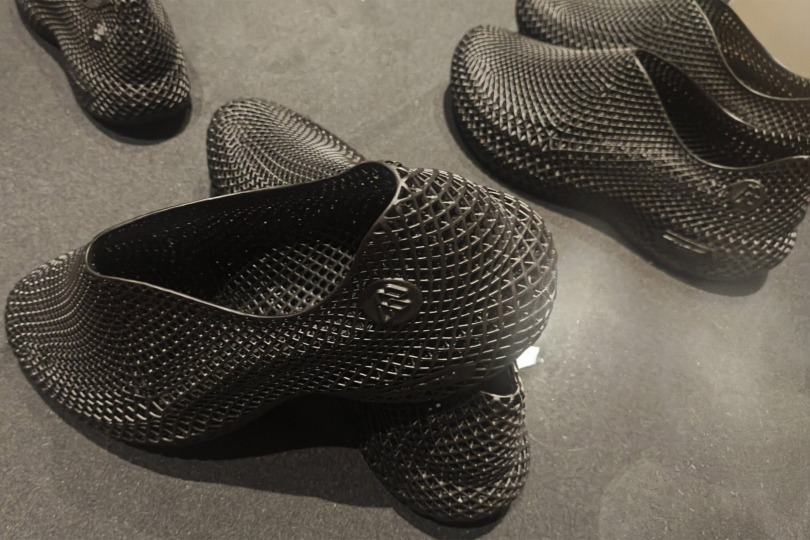
When you look at the sole of the Fitasy Stride, you won't see the usual slab of EVA foam found in most sneakers. Instead, you'll see an intricate, open-cell lattice design. This is the heart of the shoe’s performance. Traditional foam is a closed-cell material that provides decent cushioning but eventually packs down and loses its bounce. By contrast, an adaptive lattice structure can be programmed to have different densities in different areas of the same shoe.
This leads to a level of tailored shock absorption that foam simply cannot match. In our testing, the Fitasy Stride excelled as post-marathon relief. The lattice is firmer under the arch for support and softer under the heel and forefoot to absorb impact. This specific topography provides a mechanical energy return that helps your muscles recover after hours of physical activity. The lattice is also inherently breathable, with the breathable mesh upper and the open sole allowing for constant airflow, which is a blessing for tired, swollen feet.
However, users must understand the specific use case for this footwear. This is a recovery sneaker, not a performance trainer. While it is perfect for post-workout fatigue relief, casual walking, and travel, it lacks the lateral stability required for high-intensity sports. You shouldn't be using 3D printed recovery sneakers for post-workout fatigue relief during a mountain hike or a competitive basketball game; the minimalist design is meant to let your foot move naturally and recover, not to sustain heavy lateral G-forces. For its intended purpose, though, the balance of flexibility and bio-mechanical support is unmatched.
Sustainability and Inclusivity: The Circular Economy Shoe
One of the most impressive aspects uncovered in this Fitasy Stride review is the brand's commitment to the environment. The footwear industry is notoriously wasteful, but Fitasy is pushing for a circular economy. The Stride is built using monomaterial construction, meaning the entire shoe—apart from perhaps the laces—is made from a single type of recyclable TPU.
By utilizing an on-demand manufacturing model and recyclable mono-materials, Fitasy estimates it can reduce footwear-related landfill contributions by up to 70% compared to traditional brands. When the shoes finally reach the end of their lifecycle, they don't have to sit in a landfill for centuries. Because they aren't held together by a cocktail of different glues and materials, they can be easily ground down and upcycled into new products, such as athletic tracks or even new footwear components.
Beyond ecology, the on-demand production model allows for a level of social equity rarely seen in the shoe world. Fitasy offers a single-shoe purchase option for just $90. This is a game-changer for prosthetic users or individuals with significant foot size discrepancies who are usually forced to buy two pairs naturally or settle for a poor fit. This inclusive design philosophy proves that digitalization can make high-end technology accessible and practical for everyone.
The Science: Traditional shoe manufacturing requires dozens of assembly steps and multiple types of toxic adhesives. Fitasy’s use of additive manufacturing skips the assembly line entirely, printing the shoe as a near-complete unit from a single material source.
Investment Guide: Cost vs. Longevity
Let’s talk numbers. The Fitasy Stride typically retails between $180 and $210. At first glance, this might seem steep for a recovery shoe, but it is important to look at the market context. The global 3D-printed footwear market was valued at approximately $1.6 billion in 2023 and is projected to reach $5.4 billion by 2030. This growth is driven by consumers who are tired of the waste and poor fit of traditional retail.
When deciding if custom 3D printed shoes are worth the extra cost, consider the hidden costs of cheap footwear. Industry data indicates that roughly 30% of online shoe purchases are returned due to poor fit, a systemic inefficiency that drives up prices and environmental impact for everyone. By investing in a shoe that is guaranteed to fit your specific anatomy, you eliminate the cycle of returns and the physical discomfort of ill-fitting footwear.
In terms of longevity, the thermoplastic elastomer used in the lattice design is remarkably durable. Unlike foam, which has a "memory" and stays compressed over time, the TPU lattice maintains its structural integrity for hundreds of miles. While $200 is an investment, the combination of custom orthopedic alignment, environmental sustainability, and long-term durability provides a value proposition that standard $120 off-the-shelf sneakers can't compete with.
Pros and Cons: Managing Expectations
Before booking your scan, it is helpful to weigh the strengths of this technology against its current limitations.
| Feature | Pros | Cons |
|---|---|---|
| Fit & Comfort | Perfect 2-4mm custom fit based on your unique foot volume. | Requires a modern smartphone with spatial sensors to scan. |
| Performance | Excellent energy return and shock absorption for recovery. | Not suitable for high-intensity sports like running or hiking. |
| Sustainability | 100% recyclable monomaterial construction; reduced waste. | Processing and printing take roughly 5 business days. |
| Inclusivity | Single-shoe purchase options for prosthetic users. | Higher upfront cost compared to mass-produced foam shoes. |
| Design | Lightweight, breathable mesh and futuristic lattice aesthetic. | Style is distinctly tech-focused; might not suit formal tastes. |
This balance of factors shows that the Fitasy Stride is a specialized tool. It is the perfect piece of equipment for the athlete who just finished a grueling training session or the professional who spends all day on their feet and needs biomechanical support when they get home.
FAQ
Is the Fitasy Stride worth the money?
If you have unique foot shapes, chronic fit issues, or a strong commitment to sustainable products, the investment is highly justified. The durability of the TPU lattice and the precision of the custom fit provide a level of value that standard retail shoes cannot match over the long term.
What are the main features of the Fitasy Stride?
The core features include a mobile-scanned custom fit, an adaptive lattice structure for shock absorption, and a breathable mesh upper. It is constructed from a single recyclable material and designed specifically for recovery and orthopedic alignment.
Is the Fitasy Stride suitable for running or just walking?
The Stride is designed as a recovery shoe and is best suited for walking, travel, and leisure. It provides excellent comfort for low-impact movement but lacks the structural reinforcements and lateral stability required for the high-intensity demands of running or hiking.
Does the Fitasy Stride require assembly?
No assembly is required. The shoes are printed using additive manufacturing and shipped to your door as a completed product, ready for use immediately upon unboxing.
Verdict: The Cinderella Experience
The Fitasy Stride is more than just a piece of footwear; it is a proof of concept for a better way of making things. By combining digital foot mapping with localized additive manufacturing, Fitasy has created a product that solves a century-old problem of human discomfort.
If you are tired of the trial-and-error process of finding a shoe that doesn't pinch or rub, or if you simply want to support a more circular economy, the Stride is a compelling choice. While it isn't the shoe you’ll wear to run your next marathon, it is the one your feet will crave the moment you cross the finish line. Experience the future of comfort and book your scan to finally get the fit you deserve.