Quick Facts
- Target Weight: Less than 1,500 lbs, making it a true low GVWR trailer.
- Compatibility: Engineered for CUV compatibility with models like the CR-V and the electric Honda Prologue.
- Interior Height: Features a pop-up roof design providing 7 feet of standing room.
- Power Source: Equipped with a lithium-ion power bank and integrated solar cells.
- Storage: Dimensions allow for easy residential garage storage.
- Setup: Features a tool-free assembly with a setup time of under 5 minutes.
- Customization: Includes 5 modular slots for kitchenettes, showers, or climate control.
The Honda Base Station is a prototype modular travel trailer developed by American Honda R&D to lower the barrier to entry for camping for EV and CUV owners. By focusing on smart packaging and a lightweight footprint, this trailer ensures compatibility with a wide range of vehicles that traditionally lack the capacity for heavy towables.
Meet the Honda Base Station, a revolutionary modular travel trailer design specifically engineered for the modern era of mobility. Developed by American Honda R&D, this prototype targets the growing demand for lightweight campers for EVs and compact crossovers. Weighing less than 1,500 pounds, it eliminates the traditional barriers to entry-level RVing.
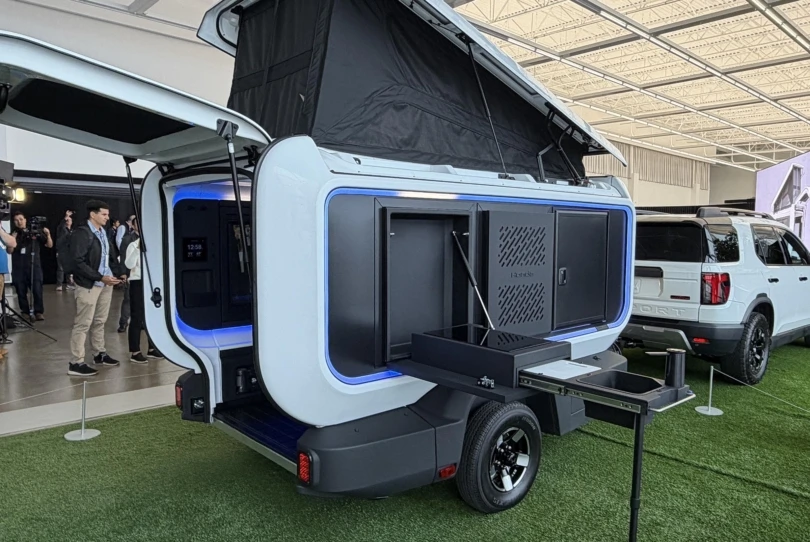
Engineering the 1,500-lb Solution for CUVs and EVs
For years, the world of travel trailers was dominated by heavy, aerodynamically challenged boxes that required a half-ton pickup truck to move. As more drivers transition to smaller crossovers and electric vehicles, the industry has faced a looming crisis: the massive weight of traditional campers kills the driving range of an EV and exceeds the Honda Base Station towing capacity for compact crossovers.
The team at American Honda R&D recognized that to democratize camping, they had to solve the weight equation. By keeping the Honda Base Station less than 1,500 pounds, engineers have created a product that virtually any modern CUV can pull without straining the transmission or cutting the battery range in half. This low GVWR trailer approach is essential for the Honda Prologue and other electric SUVs where efficiency is the primary currency.
Traditional lightweight campers for EVs often sacrifice structural integrity or interior space to shed pounds. Honda took a different path by focusing on a vehicle-based adventure philosophy. Instead of a heavy fixed shell, the Base Station uses high-strength, lightweight materials and a clever aerodynamic profile. This ensures that while you are cruising down the highway, the trailer sits quietly in the slipstream of your vehicle, preserving the efficiency of your compact crossover camping trailers setup.
The Modular Window System: Plug-and-Play Camping
What truly sets the Honda Base Station apart from everything else on the market is its modular travel trailer design. Most RVs are sold with a fixed floor plan: if you don’t like where the stove is, you’re out of luck. Honda’s solution involves five interchangeable window panels that can be swapped out based on the specific needs of your trip.
This plug-and-play system allows for unprecedented customization. Imagine you are heading out for a solo mountain bike weekend; you might want the interior to be a simple gear locker. The next weekend, if you’re taking the family, you can swap in the kitchenette module and an outdoor shower panel. The best part is the tool-free assembly. These modules lock into place securely, allowing you to transition from a gear hauler to a fully functional living space in minutes.
- Kitchenette Module: Includes a sink and prep surface for outdoor cooking.
- Shower Module: A quick-connect system for hot or cold outdoor rinsing.
- A/C Unit: A modular climate control system that can be removed when the weather is mild.
- Storage Cubbies: Extra organizational space for long-haul vehicle-based adventure trips.
This level of interchangeability means you are only carrying the weight you actually need. By customizing Honda Base Station interior and exterior modules, owners can optimize their setup for every season and destination, further enhancing the space efficiency and smart packaging that Honda is known for.
Off-Grid Living: Battery Tech and Pop-Up Comfort
One of the biggest hurdles for novice campers is managing power and water. Traditional trailers require "hookups," which limits you to crowded RV parks. The Honda Base Station is designed for a different kind of weekend—one that involves finding a quiet spot off the grid.
To facilitate this, the trailer features integrated solar cells on the roof that trickle-charge a built-in lithium-ion power bank. This battery system isn't just for lights; it’s designed to power the various modules, charge your laptops, and keep your devices running through a long weekend of off-grid battery and solar capabilities of Honda travel trailer exploration.
The interior of the trailer is surprisingly spacious thanks to the pop-up roof design. When parked, the roof extends upward to provide seven feet of interior standing headroom, making the small footprint feel like a much larger cabin. Inside, you’ll find a queen-size futon that doubles as a seating area during the day and a sleeping space at night. For families, there is even an option for bunk beds, proving that entry-level RVing doesn't have to mean cramped quarters.
Storing and Setting Up: The Garage-Integrated Camper
Perhaps the biggest barrier to own a travel trailer is where to put it when you aren't using it. Many HOAs and city ordinances prohibit parking large RVs in driveways, and storage fees can cost hundreds of dollars a month. Honda solved this by designing the Base Station for residential garage storage.
With the roof collapsed, the trailer’s height and length are compact enough to fit into a standard residential garage alongside your car. This convenience cannot be overstated for urban dwellers who want the camping lifestyle without the logistical headaches of off-site storage.
Once you arrive at your campsite, the setup is incredibly fast. Honda claims a five-minute setup time, which involves raising the pop-up roof and manual leveling using three stabilizing feet. This simplicity makes the Honda Base Station a much more approachable option than complex rigs that require thirty minutes of cranking and leveling before you can even sit down.
Market Comparison: Honda Base Station vs Airstream Basecamp
When looking at the landscape of compact trailers, the Airstream Basecamp is often cited as the gold standard. However, the Honda Base Station addresses a different segment of the market. While Airstream offers a premium, fixed-utility experience, the Honda Base Station comparison highlights a shift toward modularity and affordability.
The current outdoor industry figures show a massive influx of new participants. According to market data, there are over 80 million campers in the U.S., a population that includes 15 million first-time participants who began the activity between 2024 and 2026. These new campers are looking for the best lightweight camper trailers for EV towing under 1500 lbs rather than heavy, expensive legacy models.
| Feature | Honda Base Station (Prototype) | Airstream Basecamp 16 |
|---|---|---|
| Weight (GVWR) | Under 1,500 lbs | ~3,500 lbs |
| Towing Vehicle | Compact CUV / EV | Mid-size SUV / Truck |
| Modularity | 5 Swapable Modules | Fixed Interior |
| Storage | Fits in Standard Garage | Driveway or Storage Lot |
| Power | Lithium-ion + Solar | Lead Acid/Lithium + Solar |
| Setup Time | Under 5 Minutes | 15-20 Minutes |
The Honda Base Station vs Airstream Basecamp for crossover owners debate usually comes down to versatility. Honda’s prototype is aimed at the user who wants a multi-tool—a trailer that can be a cargo hauler on Friday and a luxury camper on Saturday.
FAQ
What is a Honda base station used for?
The Honda Base Station is a modular travel trailer designed to serve as a mobile hub for camping and outdoor activities. Its primary purpose is to provide a lightweight, easy-to-tow living space that can be customized with various utility modules like kitchens or showers, making it ideal for road trips, weekend getaways, and off-grid adventures.
Are Honda base stations compatible across different models?
While specifically showcased with the Honda CR-V and the electric Honda Prologue, the design focuses on broad CUV compatibility. Because it weighs under 1,500 lbs, it is compatible with most modern compact crossovers and electric vehicles that have a standard Class I tow hitch.
Can I move the base station to a different location?
Yes, the unit is a mobile travel trailer equipped with wheels and a standard hitch. It is designed for frequent movement and easy towing. Once at a site, it uses three stabilizing feet for manual leveling, but it can be packed up and moved to a new location in just a few minutes.
Does the base station need to be covered?
The Honda Base Station is built with durable materials intended for outdoor use. However, like any vehicle or trailer, storing it in a residential garage as intended by its design will significantly extend its lifespan by protecting the solar cells and modular seals from harsh weather and UV exposure.
As Honda continues to refine this prototype, it represents a bold step toward making the great outdoors more accessible. By focusing on the needs of the modern driver—efficiency, modularity, and ease of storage—they are proving that you don't need a massive truck to have a massive adventure. Keep an eye on American Honda R&D for further production updates on this game-changing project.